
Maverick County 72-Hour Release Status
No official Maverick County 72-hour released-inmate interface was found on the county website, Sheriff listings, or services directory. The county does not document whether any internal report uses a rolling three-day window, calendar days, or a different cutoff. It also publishes no cadence or online retention rule. A request should therefore define its own interval instead of assuming how an absent feed works.
Three days can capture events spread across a weekend, but the event must be selected by release time. Booking time answers when custody began. It does not show when custody ended. A person admitted on Friday and held Monday is not a weekend release, while someone booked earlier and released Sunday is within the requested span.
Request Maverick County Three-Day Releases
The official Maverick County open-records page directs requests to a central email. Ask for an existing jail release log for the exact interval. If the jail system has no report in that format, request the underlying booking and release entries. That wording seeks existing records instead of asking staff to create a custom list.
- Write the beginning and ending date and time in Central Time, covering exactly 72 hours.
- Send the request to openrecords@co.maverick.tx.us with the requester's name, email, and phone.
- Ask first for the existing release log or export. In the alternative, request the underlying release entries for the same span.
- Name the desired public fields: person, booking number, release timestamp, release type, releasing agency, and destination or receiving authority.
- Review transfers apart from community releases, then confirm the transfer through the receiving custodian.
The Maverick County 24-hour release request is narrower when only same-day events are needed. Both requests use the same county source but cover different time ranges.
Maverick County Three-Day Record Fields
Maverick County has not published online display fields for a three-day feed. The request can still identify fields that may exist in the jail's booking/release sheet, jail card, custody history, or equivalent. Availability is record-specific, and protected details may be withheld or redacted under Texas law.
| Field | How to read it |
|---|---|
| Name and booking number | Links the event to one booking and helps resolve a namesake. |
| Booking date and time | Shows admission, not whether release occurred during the requested window. |
| Release date and time | Determines whether the entry falls inside the exact 72-hour interval. |
| Release type or reason | May state bond, dismissal, time served, sentence completion, court order, or transfer. |
| Transferring or receiving agency | Separates the end of county custody from a return to the community. |
| Facility or releasing agency | Identifies the custodian responsible for the record and any code explanation. |
A court docket adds legal context. It can show a bond order, dismissal, judgment, jail-time credit, commitment, or community-supervision order. The jail record remains the stronger source for the minute when physical processing ended.
Use the booking number to join records across the three-day span. Names alone can collide, and one person can have more than one booking. Aliases, date of birth or approximate age, and a limited arrest range help the custodian return the correct entries. Ask staff to preserve the field labels used in the jail system. A local code should not be translated into bond, dismissal, transfer, or time served unless the custodian or record defines it.
A 72-hour response can also contain several events for one person. A release followed by a new arrest is not an error if the timestamps and booking numbers differ. Likewise, a transfer may appear at the end of county custody while the receiving system records intake later. Keep each custodian's event separate and arrange them by time. This avoids turning a short reporting delay into an unsupported claim that the person was free between agencies.
Maverick Weekend Release Verification
No authoritative Maverick County source published a weekend or holiday release schedule. A court date, bond posting, or sentence endpoint should not be converted into a promised exit hour. Administrative review, another hold, a transfer, or completion of jail processing can separate the legal event from physical release.
A 72-hour request helps by covering the whole span rather than relying on an assumed weekday refresh. Yet it still needs fixed timestamps. If a response was generated after the interval, compare each release time rather than accepting a report title at face value. For a specific person, the Maverick County released-inmate path routes the check through the county, court, TDCJ, federal, or ICE system as needed.
Note: Maverick County publishes no Friday-release promise, holiday rule, or fixed exit time, so confirm current procedure with jail staff.
Maverick County Release Channel Chain
Call the Sheriff's published line at 830-773-2321 when the right record or custodian is unclear, then preserve the request in writing. If the returned county entry says TDCJ, the state offender search covers current state imprisonment, while TDCJ email and Open Records provide the historical fallback. TDCJ's current search is not an archive of everyone released from Maverick County Jail.
Texas IVSS-Counties can supply participating county events and notices, but Maverick County availability must be checked in the live portal. TDCJ IVSS is a separate state post-conviction system. BOP records cover federal custody, PACER explains federal court events, ICE ODLS covers eligible immigration custody, and USMS has no nationwide former-detainee locator. Each source must be read within its own scope.
A release response may arrive after the desired period because the Public Information Act's procedural deadlines do not guarantee full production within a fixed number of days. Clarification, cost estimates, redactions, and legal review can affect timing. The returned record is still useful as an archive.
Keep the request, response, and query date together. If a later record changes the destination or event code, ask the Sheriff for the source entry and an explanation of the corrected field. That preserves the sequence without treating the first response as permanently complete.
For a TDCJ transfer, search by TDCJ or SID number when one is available and compare the conviction county and offense. The public TDCJ page reports current incarceration and is at least one working-day update behind according to its own notice. It is not a released-person archive. If the person no longer appears, use TDCJ's inmate-information email or Open Records for incarceration history and state release or discharge facts.
Maverick County Three-Day Data Gap
The distinctive local fact is the absence of an authenticated recent-release tool. The county services directory does not provide a three-day release view, archive span, refresh frequency, or photo-retention rule. Commercial pages with official-sounding names do not cure that gap. Their source, update time, and retention can be unknown.
The official request screen below is the supported substitute for the absent feed. It does not claim to be a live roster.
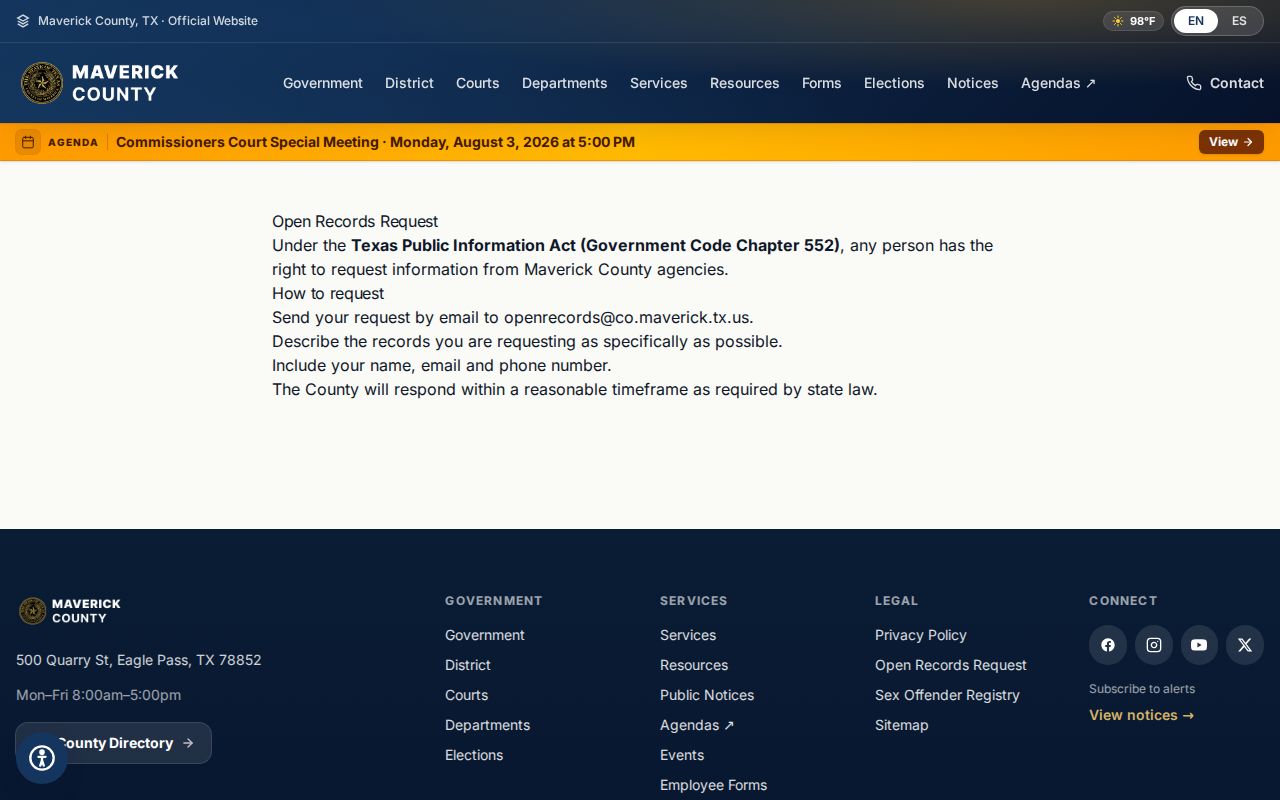
A written, date-bounded response can be compared with the court docket and any named receiving agency. That chain is more reliable than inferring release from a missing roster entry.
Maverick Release Versus Transfer
"Released" can describe only the end of the Sheriff's custody episode. A bond, personal bond, dismissal, time served, or completed county sentence may return a person to the community when no other hold exists. A transfer instead moves the person to another county, TDCJ, U.S. Marshals, or immigration custody.
- Community release
- The person leaves physical custody, though a pending case or supervision terms may remain.
- Transfer
- One custodian relinquishes the person directly to another authority.
- Discharge
- A sentence or supervision term reaches its formal endpoint; it is not just departure from one jail.
- Detainer
- A request or hold tied to another authority that may affect the next custody step.
Ask for destination fields exactly as stored. When a transfer code is vague, contact the agency that created the code before describing where the person went.
Federal and immigration routes require the same care. A BOP result marked released establishes only the BOP endpoint. U.S. Marshals pretrial or transport custody has no comparable public former-detainee locator, so the federal docket and a targeted records request fill that gap. ICE's locator can cover eligible people recently released from ICE custody, but that event does not reveal whether the person entered the community, departed the country, or moved to another authority.
In a border county, a Sheriff release time and an ICE custody event can occur close together. The county record should identify the transfer if that field exists. Search ICE using the precise A-number and country of birth when possible, record the query time, and read the returned wording literally. A missing ICE result is inconclusive because exact matching, processing delay, and public-locator limits can affect the search.