
Maverick County Parole Versus Probation
Texas separates state parole from local community supervision. The Texas Board of Pardons and Paroles decides parole and discretionary mandatory-supervision release. The TDCJ Parole Division supervises a person after that state release. A Maverick County court orders probation, and the serving Community Supervision and Corrections Department carries out the court's terms under TDCJ-CJAD oversight.
| Feature | Parole or mandatory supervision | Probation/community supervision |
|---|---|---|
| Source | State-prison sentence and BPP release process | Criminal court judgment or supervision order |
| Decision maker | Texas Board of Pardons and Paroles under state law | The sentencing court |
| Supervising system | TDCJ Parole Division | The serving CSCD |
| Primary verification | TDCJ identifiers, BPP status, release certificate, Parole Division | Cause number, judgment, community-supervision order, court and CSCD |
| End record | TDCJ discharge or other formal status | Court or CSCD completion and discharge documentation |
A person can leave Maverick County Jail on bond while the case remains pending. That event is not parole and is not probation. Likewise, parole eligibility only means a state case can be considered. It does not show approval, physical release, or active supervision.
- Parole
- Conditional release from state incarceration for the rest of a sentence under set terms.
- Probation
- Court-ordered community supervision, which may be imposed instead of or after confinement.
- Mandatory supervision
- A Texas state release governed by sentence credits, offense-date law, eligibility, and in newer cases discretionary BPP review.
- Discharge
- The formal endpoint of a sentence or supervision term, not merely departure from a facility.
Verify Maverick County Post-Release Supervision
Start with the legal source of supervision. A state-prison commitment points to TDCJ and BPP. A Maverick County community-supervision order points to the sentencing court and serving CSCD. Similar names are common, so use a TDCJ number, SID number, cause number, birth date, and conviction facts where permitted.
- Identify whether the last sentence was county/community supervision or TDCJ imprisonment. Do not infer the answer from a jail roster.
- For state parole, open TDCJ Inmate Information and match identifiers, offense, and conviction county.
- Check the BPP parole-status route. Read the exact decision code and next review or approval conditions.
- After a favorable vote, contact Review and Release Processing for release-certificate status. Confirm actual release to supervision through TDCJ or Parole Division records.
- For probation, obtain the judgment and community-supervision order from the Maverick County clerk that serves the sentencing court.
- Use the order or statewide CSCD directory to identify the department actually serving the case, then ask that office for public status or discharge records.
The Maverick County released-inmate record path helps identify the right court when the custody chain is unclear. Felonies route through the District Clerk; county-level matters begin with the County Clerk, while lower-level cases can belong to municipal or justice court.
Texas parole review is a file-vote process, not a conventional public hearing with a courtroom calendar. TDCJ identifies cases before the eligibility or review point, an Institutional Parole Officer prepares a case summary, and a three-member panel votes the file. Two matching votes decide the case. A denial can include a later review date, while an approval may include a program, date, residence, or other condition. Read the official vote code rather than reducing every result to approved or denied.
Eligibility is only the first statutory point at which review may occur. Government Code chapter 508 and the law in effect for the offense control the calculation. For some offenses, calendar-time thresholds apply and good-conduct time does not speed the initial eligibility point. A projected release date, maximum sentence date, parole eligibility date, next review date, and scheduled release date each answer a different question. Copy every label exactly and do not treat the earliest one as the physical release date.
Maverick County State Parole Contacts
TDCJ's state contacts apply only to parole and mandatory supervision. They do not manage a Maverick County probation order. The research found no authoritative local special check-in or walk-in policy, so no local practice should be assumed.
TDCJ Review and Release Processing8610 Shoal Creek Boulevard
Austin, Texas
Release-status line: 512-406-5202
Official review and release information
A favorable BPP vote can still await release-plan review, approved residence, required programs, record audit, and certificate issuance. Published processing estimates describe typical agency work, not a guarantee for one Maverick County case. Physical custody status is the final release check.
The official parole-review page shown below describes the Texas file-review process used for state cases.
Open the TDCJ parole review process.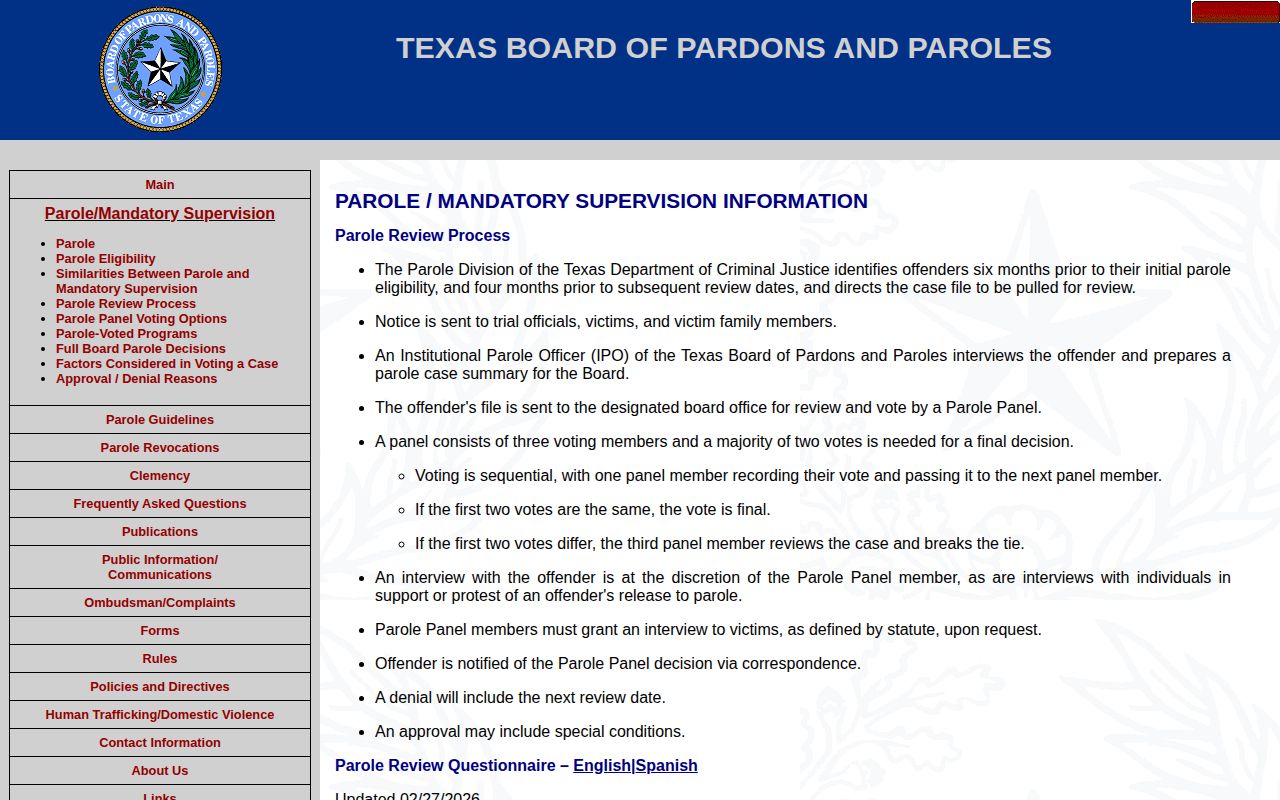
The process page supplies review context, while person-specific status still comes from BPP, TDCJ, and the supervising office.
TDCJ reports that approval processing can include a residence-plan check, county-of-residence rules, required program completion, release-certificate preparation, and a records audit. Those steps explain why an approval date and an exit date may differ. The BPP status line is the person-specific decision route, while Review and Release Processing handles status after favorable action. Neither office should be used to verify a Maverick County bond release or a probation order that never involved TDCJ.
Maverick Supervision Conditions and Warrants
Conditions are the rules attached to release or a court order. They can include reporting, residence approval, treatment, fees, travel limits, or other case-specific duties. The signed release certificate or community-supervision order controls. A broad summary cannot replace those documents.
An absconder is a person reported as no longer complying with required supervision contact. A warrant indicator can show that enforcement is active, but it does not prove a new conviction. The absence of a name from a public list also does not prove compliance or discharge. Verify status with the agency that supervises the person and avoid relying on a stale screenshot.
TDCJ IVSS can send eligible post-conviction notices about parole review, release to supervision, discharge, and warrant actions. A notification is an alert, not a certified record. Obtain the underlying TDCJ or court record when exact legal status matters.
A violation allegation can lead to a warrant, revocation process, modified conditions, or a return to custody. It is not itself a new conviction. If a public status uses terms such as warrant or absconder, record the agency and update time, then ask the Parole Division or serving CSCD for the public status it can provide. Do not publish reporting locations, schedules, or other operational details that could help someone avoid supervision.
Maverick County Supervision Discharge
Supervision ends through a formal action, not through silence in an online lookup. For state parole or mandatory supervision, ask TDCJ for the recorded discharge or current status. For probation, seek the court or CSCD record showing completion, early termination, revocation, or discharge. A completed reporting term should not be presumed from the original end date because later court or agency action may change it.
Texas Government Code chapter 508 governs parole and mandatory supervision. A Parole Division record can distinguish active supervision from discharge. A Maverick County court record can show whether community supervision was completed, modified, revoked, or replaced by another judgment. Keep those systems separate when reporting the outcome.
Note: Release from physical custody and discharge from legal supervision are separate events and can occur years apart.
Maverick County Probation Office Routing
A Maverick County probation order must be obtained from the sentencing court and routed to the CSCD serving that order. The TDCJ Community Justice Assistance Division oversees Texas community-supervision departments but does not turn probation into state parole. The TDCJ Parole Division handles parole and mandatory supervision only.
Use the cause number and order to identify the department, office, and reporting terms. The supervising CSCD may differ from the county of conviction when a case is transferred for service. No reliable local source documented a special Maverick walk-in schedule, so contact the named department before appearing at an office.
The judgment can show the supervision term, offense, court, conditions incorporated into the order, and the department responsible for service. Later docket entries can show modification, revocation, early termination, or completion. Ask for the specific order rather than requesting that clerk staff decide whether the person is compliant. Compliance is an agency determination, while the filed order and docket are existing court records.
Can a parole office confirm probation? No. The record must be routed by its legal source. A parole contact can address TDCJ supervision, while a court and CSCD address community supervision.
Maverick Release Notification Layers
Texas now uses separate notification layers. IVSS-Counties supports participating county jail and court events, while TDCJ IVSS covers prison, parole, mandatory-supervision, discharge, and warrant events. Maverick County participation in the county portal must be checked live rather than assumed.
A county "released" alert identifies that reporting agency's event. It may precede a transfer. A TDCJ notice names the state event but does not resolve a separate county or federal case. Search the person with precise identifiers, save the notice time, and confirm through the source agency.
Texas replaced its legacy county VINE service with IVSS-Counties in 2025, and prior registrations were moved according to the Attorney General's notice. Users should review migrated preferences and current confirmation steps. The older four-digit telephone PIN workflow belongs only to the superseded system and should not be used as current registration guidance. TDCJ IVSS remains a separate post-conviction service for prison and parole events.
Keep the alert with the later official response. A delayed or corrected notice does not replace the signed order, release certificate, or discharge record.